
Product Safety for 3D Print Sellers: Toys, Food Contact and Candle Holders
By Ryan Dacus · Published · Facts last checked October 19, 2026 · 8 min read
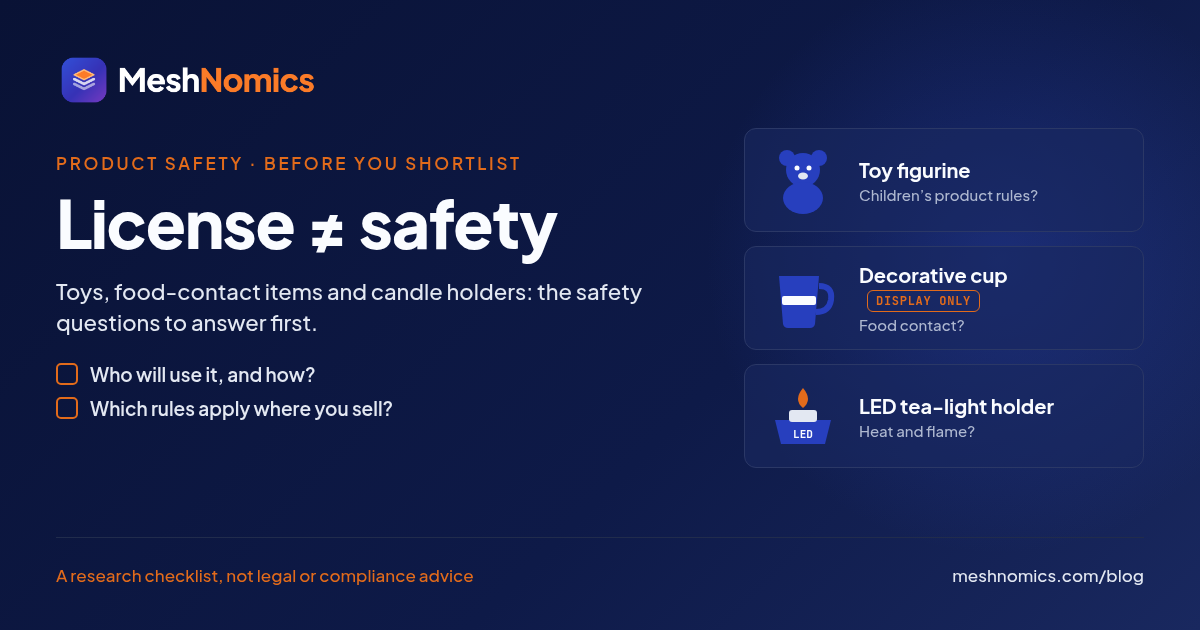
If you already sell on Etsy, eBay, Amazon Handmade or your own store, "is it legal to sell this print?" usually gets answered as a license question: commercial use, Creative Commons, Etsy's original-design rule. Those matter. They don't answer whether the product is safe in a child's hands, against food, or around an open flame—and a "decorative only" label doesn't erase foreseeable use.
This post is a product-safety overview for three categories that show up in seller shortlists—children's products/toys, food-contact items and candle holders—with primary sources to check before you print a batch. It is a research aid, not legal or regulatory advice. Rules vary by country, product and how you market it. Verify each design's license on its source page, and talk to a qualified advisor for your own products.
The short version
- A license is not a safety certificate. Commercial-use permission covers the design file. It says nothing about lead, small parts, food-contact status or fire risk.
- Children's products in the US are their own category. CPSC treats a product designed or intended primarily for children 12 or younger as a children's product. Third-party testing generally applies to the relevant safety rules unless valid testing relief applies; assess Children's Product Certificate and tracking-label obligations separately (CPSC: Children's Products; CPC; Tracking Label FAQs).
- Food-contact claims need authorized materials, not a filament brand name. FDA says a food-contact article's status depends on each substance reasonably expected to migrate to food (FDA).
- Printed holders and open flame don't mix. Prusa's guidance: use LED tea lights or fairy lights, never real candles inside a 3D-printed model (Prusa blog).
- Labels are not a workaround. A "not a toy" or "display only" disclaimer is one factor among several; marketing, photos and foreseeable use still count (CPSC).
Toys and children's products (US)
CPSC defines a children's product as a consumer product designed or intended primarily for children 12 years of age or younger. Classification looks at the manufacturer's stated use, packaging and advertising, how consumers commonly recognize the product, and the Commission's Age Determination Guidelines—not only a "not a toy" disclaimer (CPSC: Children's Products). CPSC's own FAQ: you cannot simply label a product to ensure it is not considered a children's product; any label must be reasonably consistent with expected use patterns. If your print is primarily for kids, expect children's product rules to come into play. CPSC's guidance: if unsure, err on the side of meeting those rules, or ask Compliance for a staff view.
For children's products subject to children's product safety rules, domestic manufacturers and importers generally must do the three things below. CPSC's certificate and testing pages also describe exemptions for certain products and materials, and testing relief for qualifying small-batch manufacturers that register with CPSC. Being a small shop doesn't exempt you by itself, and testing relief doesn't remove the certificate requirement. Work out which requirements, and which valid exceptions, apply to your specific product.
- Get third-party testing from a CPSC-accepted laboratory for the applicable rules, unless a valid exemption or testing relief applies (Initial Certification Testing).
- Issue a Children's Product Certificate (CPC) based on applicable test results or documented exemptions or determinations (CPC guidance).
- Affix tracking labels (permanent, visible, legible marks identifying the firm, production location and date, and batch/run or similar source info) on the product and packaging to the extent practicable (Tracking Label FAQs). Tracking labels themselves are not third-party tested.
Which tests apply depends on the product. Three rules sellers of printed toys often run into:
| Topic | What CPSC says (high level) | Primary source |
|---|---|---|
| Small parts | Children's products intended for children under 3 that present a choking, aspiration or ingestion hazard because of small parts are banned. A small part fits entirely into the small-parts cylinder. | Small Parts guidance |
| Lead | Children's products with more than 100 ppm total lead in an accessible component are banned hazardous substances. | Total Lead Content; 15 U.S.C. 1278a |
| Phthalates | Children's toys and child care articles must not contain more than 0.1% (1000 ppm) of eight listed phthalates in an accessible plasticized component. | Phthalates guidance |
CPSC's Regulatory Robot walks through product questions and points at likely requirements. It is guidance, not a certificate. Have a qualified reviewer assess classification, the applicable rules and any exemptions for your product; this post is not a complete compliance checklist.
Layer this on top of the license and channel checks in Can you legally sell 3D prints from Thingiverse, Printables or MakerWorld?. On Etsy, 3D-printed items must still be based on your own original design under the Creativity Standards, whatever the file's license says.
Food-contact items
A place-card holder next to a plate is not the same claim as a cup, utensil, cookie cutter or bowl marketed for food use. FDA: the regulatory status of a food-contact material is dictated by each individual substance that comprises the article. Any substance reasonably expected to migrate to food needs coverage under one of: a Title 21 CFR regulation, GRAS criteria, a prior sanction, a Threshold of Regulation exemption, or an effective Food Contact Substance Notification (FDA: determining regulatory status; packaging & FCS overview).
- Regulatory status isn't a finished-print safety check. Establishing a component's regulatory status doesn't certify that your finished print is safe or cleanable. And an effective food-contact notification applies to the manufacturer and intended use it names, so check that it matches your actual material supplier and use (FDA).
- A spool label is not a finished-article authorization. Layer interfaces, colorants and additives all matter for the finished print and intended use.
- Don't invent a food-safe claim. If you can't document authorization for the substances and conditions of use (food type, temperature, single- vs repeat-use), keep the listing honestly decorative—and don't rely on a "display only" line if your photos, title or foreseeable use still invite food contact. That framing is listing honesty, not a path around how the product will actually be used.
- Coatings don't erase the question. A food-contact coating is itself a food-contact substance with its own status requirements.
The Christmas 3D prints post flags table décor the same way: keep it decorative unless you can back a safety claim.
Candle holders, tea lights and heat
Seasonal luminaries are popular downloads. Popularity is model interest, not sales—and not a safety sign-off.
Prusa's Halloween 2026 post: do not use real candles; use battery-powered LED tea lights or fairy lights. "The heat and fire of a normal candle inside a 3D-printed model is a very bad idea" (Prusa blog).
That's one maker's guidance for the decorative printed models in that post. It isn't proof about every printed material or design, and it doesn't certify every LED setup as safe. Say "LED only" in the listing. Design the recess for an LED tea light so a real candle is an awkward fit. Don't invent fire-code compliance you haven't verified. This is maker-safety guidance and listing honesty, not a substitute for local rules.
A license says nothing about safety
Keep three research layers separate, as in the research guide:
- Model interest. Downloads (and better, downloads gained between two dated checks) show where attention is moving. They are not sales.
- Marketplace signals. Comparable listings on Etsy, eBay, Amazon and elsewhere—asking prices, reviews and purchase indicators. Asking prices aren't proof of what anyone paid.
- Your own test—including category safety. Can you truthfully describe who this is for, what it touches, and what heat source it accepts? If the answer needs lab testing or food-contact documentation you don't have, that SKU stays off the shortlist or stays honestly decorative without inviting the risky use.
A commercial license answers permission to use the design. It does not replace applicable CPSC requirements, an FDA food-contact path or a heat warning. Many popular models are non-commercial anyway (what CC BY-NC means). Verify each design's license. A license flag in any tool, including ours, is a research aid, not legal advice.
EU note (short)
If you place products on the EU market, Regulation (EU) 2023/988 (GPSR) applies from 13 December 2024 (Art. 52) to non-food consumer products sold offline or online (EUR-Lex; Commission factsheet). Before placing products on the market, manufacturers must ensure they meet the general safety requirement, carry out an internal risk analysis and draw up technical documentation (Art. 9). A product covered by the GPSR can't be placed on the EU market unless an economic operator established in the EU is responsible for it (Art. 16). Product-specific EU rules (including toys) can sit on top. Orientation only—not a compliance checklist.
Checklist before you shortlist a SKU
- Who is it for? Primarily children 12 or under (US factors), adults, or unclear? Marketing and photos count; a disclaimer alone does not settle it (CPSC).
- Does it touch food or drink? If yes, can you document food-contact status for the substances and conditions of use (FDA)? If not, redesign away from food contact or drop it—don't treat "decorative" as a shield for foreseeable food use.
- Heat or open flame? LED only, and say so (Prusa).
- License and channel. Commercial permission at the source; on Etsy, your own original design (post 01).
- Cost the compliance work. Third-party tests, labeling and documentation are real lines for a shop already shipping. Run production cost in the free 3D print cost calculator, then add compliance as its own line. Pricing formula: How to price 3D prints.
Research the interest; don't skip the category
MeshNomics helps you compare model interest and marketplace signals and see a recorded license flag on each design (verify it at the source). It does not certify product safety, food-contact status or regulatory compliance. Cost-planner outputs are estimates, not a forecast of sales or profit.
👉 Start a 30-day Operator trial, no card →. Founding accounts created by Dec 31, 2026 (Pacific) get Operator at $9.99/mo for their first 12 paid months, then $19.99.
Related: What to 3D print and sell: a research guide · Christmas 3D prints to sell in 2026 · Methodology
FAQ
Is it legal to sell 3D printed toys? This post is not a yes/no legal answer. In the US, selling a children's product means complying with applicable CPSC children's product safety rules—not only having a commercial license for the file. Check CPSC guidance for your product, and get qualified advice for your own SKUs.
Can I sell 3D printed cups or cookie cutters as food-safe? Only if you can support food-contact status for the substances and intended use under FDA's framework. A filament brand name alone isn't that documentation. Otherwise, don't invite food use in the listing or the design.
Are 3D printed candle holders safe with real candles? For decorative printed models like the ones in Prusa's guidance, no: Prusa says to use LED tea lights or fairy lights instead of real candles, and you should state that in the listing. That guidance covers the models it discusses. It isn't proof about every printed material or design, and it isn't a safety certification for every LED setup.
Does a commercial license cover safety? No. A license covers rights in the design. Product safety is a separate obligation.
Does a "not a toy" or "display only" label clear me? Not by itself. CPSC considers stated use alongside packaging, advertising, common recognition and Age Determination Guidelines; a label must fit expected use patterns. FDA food-contact questions turn on substances and conditions of use, not a disclaimer alone.